What a Weekly Pool Maintenance Visit Actually Covers
A good maintenance visit is a short list of jobs done consistently, and the point is to catch problems before they grow.
October 27, 2026 · 4 min read
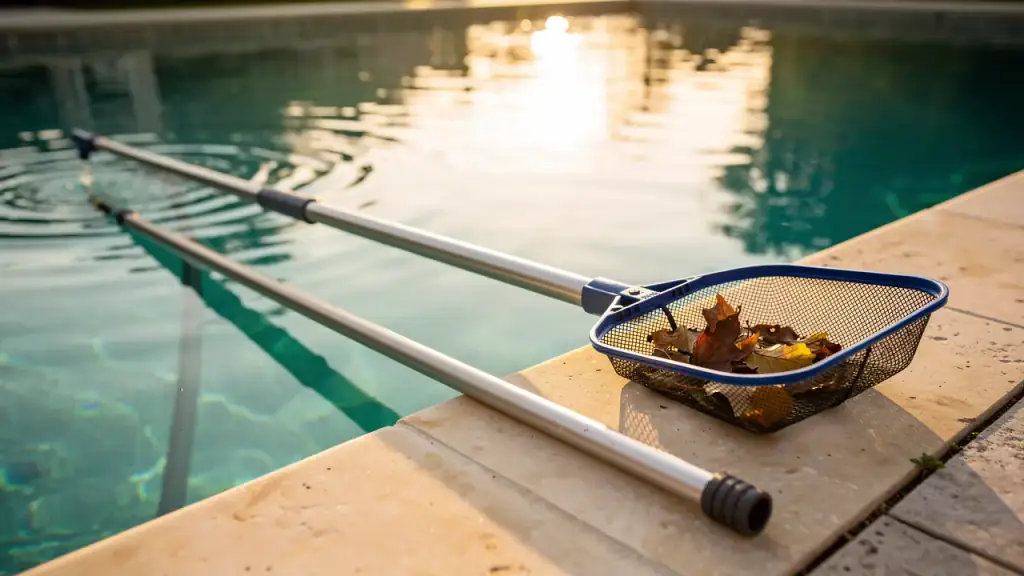
People who hire a pool service often don't know what happens during the visit. They see a truck, a person walking around the pool, and a clean pool afterward. That's fine, but it helps to know what the work is, because the steps aren't random. Each one handles a specific way a pool goes wrong.
A regular maintenance visit for a residential pool generally comes down to five jobs: brushing the walls, cleaning the filters, testing and adjusting the chemicals, skimming the water, and inspecting the equipment. Here's what each one does.
Brushing the walls
Algae doesn't start as a green pool. It starts as a thin film on the walls, steps, and corners, usually in places where water doesn't move much. Brushing breaks that film up before it takes hold and pushes it back into the water, where the filter and sanitizer can handle it.
It also keeps scale and dirt from building up on the surface, and it helps the water circulate along the walls. Steps, ladders, behind lights, and tight corners tend to get the worst of it, so a thorough brushing goes beyond the easy flat areas.
Cleaning the filters
The filter is the part of the pool that does the real cleaning. Water gets pulled out, pushed through the filter, and sent back, and whatever the filter catches stays behind. Over time that material builds up and the filter has to work harder to push water through.
What cleaning looks like depends on the type of filter. Sand, cartridge, and diatomaceous earth filters are all different, and each one has its own routine. A cartridge may be pulled out and rinsed. A sand filter may be backwashed. A clogged filter means weaker circulation, and weaker circulation means cloudy water, algae, and a sanitizer that can't spread evenly. Many pool problems that look like chemical problems turn out to be filter problems.
Skimmer baskets and the pump basket get checked in the same pass. Those catch leaves, bugs, and hair before they reach the pump. A full basket restricts the water flow and strains the pump.
Testing and adjusting the chemicals
This is the step most owners worry about, and it's really about balance. A pool needs a sanitizer, usually chlorine, to keep bacteria and algae in check. It also needs the water itself to be in a comfortable, stable range. Pool pros commonly watch a handful of readings, including sanitizer level, pH, alkalinity, and stabilizer, and each one affects the others.
pH is a good example. Typically, pH is kept in a mildly basic range. If it drifts too high, chlorine becomes less effective and scale can form. If it drifts too low, the water gets harsh on skin, eyes, and equipment. Alkalinity acts as a buffer that keeps pH from swinging around. And in sunny weather, a stabilizer helps keep sunlight from burning chlorine away too fast.
Testing at every visit matters because pools change all the time. Rain dilutes the water. Heat burns off sanitizer faster. A crowded pool afternoon uses it up. Pollen season and heavy leaf drop add more demand. Adjusting a little each week is easier and cheaper than correcting a pool that has gone way off, and a pool that's gone way off is hard on the surface and equipment as well as the swimmers.
Skimming the water
Skimming removes what floats: leaves, bugs, pollen, bits of grass. It sounds basic, but it matters for the chemistry too. Organic material in the water uses up sanitizer as it breaks down. The less of it that gets to sink to the bottom and decay, the less work the chlorine has to do.
Southern Maryland has plenty of trees, and the pollen and leaf seasons are no secret to anyone who parks a car outside. A pool in the shade of a few mature trees can fill with debris after one windy afternoon.
Inspecting the equipment and recommending repairs
This is the step that separates a pool service from a cleaning. While the technician is working, they're looking at the pump, the filter, the heater, the lines, and the fittings. They're listening for noises, checking the pressure reading on the filter, and looking for drips, rust, and wear.
The point is to find problems when they're small. A weeping pump seal, a gauge reading that keeps creeping up, a fitting that's starting to crack. None of those is dramatic on its own. Left alone for a season, any of them can turn into a failed pump or a flooded equipment pad. A technician who sees your equipment every week knows what normal looks like for your pool, so they notice when something changes.
When the technician finds something, the useful response is a clear recommendation: what's wrong, what it likely needs, and how urgent it is. You decide what to do from there.
Moonlight Pool and Spa Service offers residential pool maintenance for homeowners in California, Leonardtown, Hollywood, and Lexington Park, and its tagline says it plainly: we maintain your pool and spa so you don't have to. See the Residential pool maintenance page for details, or call (410) 610-8036.
Moonlight Pool & Spa Service, (410) 610-8036
Call (410) 610-8036More articles
Closing Your Pool for a Southern Maryland Winter, and Opening It Again in Spring
A pool closing is mostly about keeping water out of places it can freeze, and an opening is where you find out if that worked.
Three Signs Your Pool Equipment Needs a Repair, and What Each One Usually Means
Pool equipment rarely fails without warning, and the warnings come as leaks, rust, and noise.