Three Signs Your Pool Equipment Needs a Repair, and What Each One Usually Means
Pool equipment rarely fails without warning, and the warnings come as leaks, rust, and noise.
October 27, 2026 · 4 min read
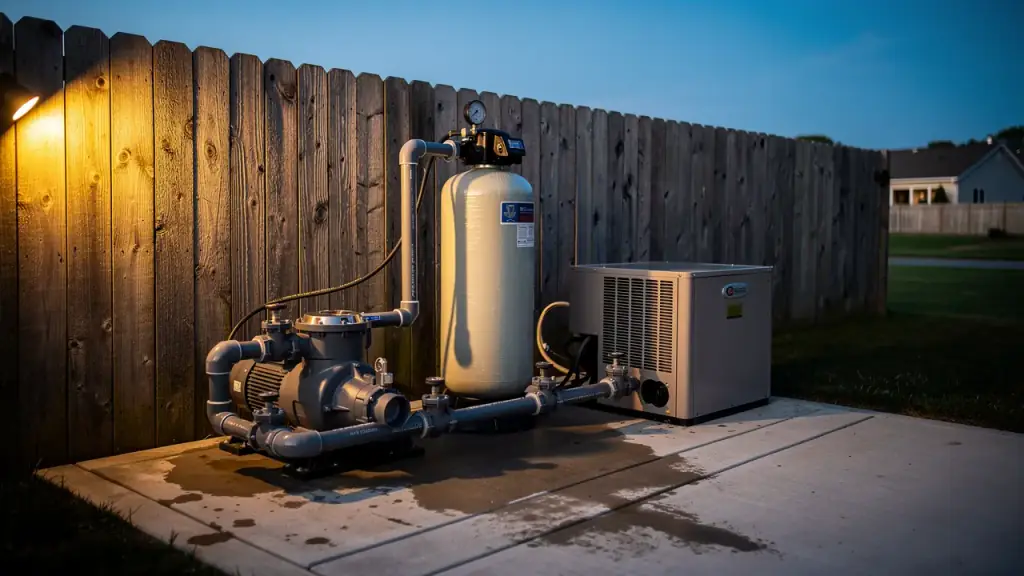
Most pool equipment problems start small. A damp spot on the pad. A little orange along a bolt. A pump that sounds slightly different than it did last month. Owners tend to notice these things and decide to keep an eye on them, which is reasonable for about a week. After that, small problems have a way of becoming the expensive kind.
Three signs are worth taking seriously: the pool is leaking, the equipment is rusting, or the equipment is making an odd noise. Here's what each can mean and what to do about it.
Sign one: your pool is leaking
Every pool loses some water to evaporation, and Southern Maryland summers are hot and sunny enough that the level drops on its own. A leak is different. It's a loss that keeps going when the weather doesn't explain it, or water showing up somewhere it shouldn't be.
Where the water is turning up tells you a lot. Leaks tend to fall into a few groups:
- Around the equipment: water at a pump seal, a union, a filter fitting, or a valve. These are often the cheapest to fix, and the easiest to find because you can see them.
- In the plumbing: lines running between the pool and the equipment can crack or loosen underground. These show up as a falling water level, soggy ground, or a pump that keeps losing prime.
- In the pool structure: fittings, skimmers, and lights set into the pool wall can leak at the seal.
- At the heater: a heater that drips can have a failed connection or an internal problem, and it should be looked at before it runs again.
A simple check many pool people suggest: put a bucket of water on a pool step, mark the water level inside the bucket and outside it, and compare after a day or two. If the pool drops much more than the bucket, evaporation isn't the whole story. That test doesn't find the leak, but it tells you whether you have one.
A leaking pool wastes water and chemicals, and it can wash out soil around the pool or equipment pad. The sooner it's found, the smaller the repair tends to be.
Sign two: your equipment is rusting
Pool equipment lives in a rough spot. It's outdoors, it's wet, and it sits near chemicals. Some surface rust on a bolt or a bracket is common and not an emergency. Rust that keeps coming back, flakes off in layers, or collects around the pump, heater, or filter base is a different story.
Rust is a message that moisture is hanging around where it shouldn't. Sometimes that's a slow drip that nobody has noticed. Sometimes it's poor drainage around the pad, or chemical fumes collecting in a closed-in equipment area. Sometimes it's simple age, and the metal parts are wearing out.
What matters is the cause. Painting over rust or wiping it off helps the look, but if a hidden leak is feeding it, the rust returns and the leak keeps growing. A technician looking at rust will usually trace it back: where is the moisture coming from, and what is the metal protecting? A rusted bolt is a nuisance. A rusted heater casing or pump motor housing is a warning about parts that are expensive to replace.
Sign three: your equipment is making an odd noise
A healthy pump has a steady hum. When that changes, the pump is telling you something, and different sounds usually point at different problems.
- A high whine or screech often points at worn motor bearings.
- A rattling or grinding sound can mean debris inside the pump, or bearings failing.
- A gurgling or sputtering sound usually means air is getting into the system, often through a loose fitting, a low water level, or a clogged basket or line.
- Loud humming with no water movement can mean the motor is trying to run and can't, which is a reason to shut it off promptly.
Noise matters because pumps run for hours every day. A pump that runs with a failing bearing or while sucking air is working harder than it should and heating up. Run it long enough and a repair that might have been a bearing or a seal becomes a new motor.
What to do while you wait for a visit
If you can see a leak, turn the equipment off until someone has looked at it, since running a leaking system can drain the pool and damage the pump. If a pump is screaming or grinding, switch it off. Take a few photos or a short phone video of the noise, the leak, or the rust, because that helps when you describe the problem. And write down when it started and whether it's getting worse.
If you aren't sure, ask for an inspection
Plenty of owners aren't sure whether something counts as a problem. That's fine. A pump that sounds a little different or a damp spot that comes and goes can be nothing, or it can be the first sign of something that gets worse. Having someone look is cheaper than guessing wrong.
Moonlight Pool and Spa Service repairs pumps, heaters, and other pool equipment for homeowners across St. Mary's County, and its team can come out to inspect your equipment if you're not sure it needs repair. See the Pool repair page for what's covered, or call (410) 610-8036 and describe what you're seeing.
Moonlight Pool & Spa Service, (410) 610-8036
Call (410) 610-8036More articles
Closing Your Pool for a Southern Maryland Winter, and Opening It Again in Spring
A pool closing is mostly about keeping water out of places it can freeze, and an opening is where you find out if that worked.
What a Weekly Pool Maintenance Visit Actually Covers
A good maintenance visit is a short list of jobs done consistently, and the point is to catch problems before they grow.